Reports: Financing for Animal Health: A Gap in the Sustainability Agenda
Financing for Animal Health: A Gap in the Sustainability Agenda is an analysis of global climate finance flows to assess how much support is currently directed towards livestock health. It examines current investment levels, identifies benefits of improving livestock health, and highlights opportunities to better align financing with sustainability goals.
The paper provides a new datapoint for global discussions, finding that livestock health receives just 0.01-0.02% of global climate finance. Read the full paper below or download it here.
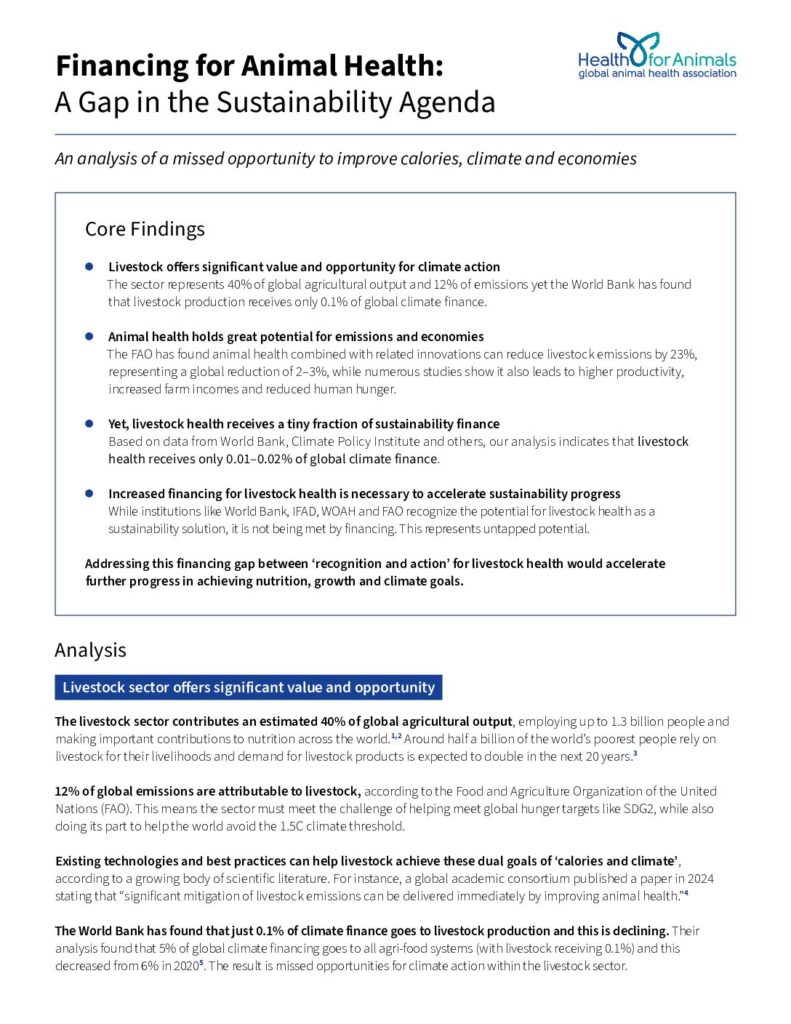
Core Findings
- Livestock offers significant value and opportunity for climate action
The sector represents 40% of global agricultural output and 12% of emissions yet the World Bank has found that livestock production receives only 0.1% of global climate finance. - Animal health holds great potential for emissions and economies
The FAO has found animal health combined with related innovations can reduce livestock emissions by 23%, representing a global reduction of 2–3%, while numerous studies show it also leads to higher productivity, increased farm incomes and reduced human hunger. - Yet, livestock health receives a tiny fraction of sustainability finance
Based on data from World Bank, Climate Policy Institute and others, our analysis indicates that livestock health receives only 0.01–0.02% of global climate finance. - Increased financing for livestock health is necessary to accelerate sustainability progress
While institutions like World Bank, IFAD, WOAH and FAO recognize the potential for livestock health as a sustainability solution, it is not being met by financing. This represents untapped potential.
Addressing this financing gap between ‘recognition and action’ for livestock health would accelerate further progress in achieving nutrition, growth and climate goals.
Analysis
Livestock sector offers significant value and opportunity
The livestock sector contributes an estimated 40% of global agricultural output, employing up to 1.3 billion people and making important contributions to nutrition across the world.1https://www.fao.org/animal-production/en/,2https://openknowledge.fao.org/server/api/core/bitstreams/0c1bfa99-18d4-42e4-b94f-27160126f826/content Around half a billion of the world’s poorest people rely on livestock for their livelihoods and demand for livestock products is expected to double in the next 20 years.3https://academic.oup.com/af/article/11/5/20/6404341
12% of global emissions are attributable to livestock, according to the Food and Agriculture Organization of the United Nations (FAO). This means the sector must meet the challenge of helping meet global hunger targets like SDG2, while also doing its part to help the world avoid the 1.5C climate threshold.
Existing technologies and best practices can help livestock achieve these dual goals of ‘calories and climate’, according to a growing body of scientific literature. For instance, a global academic consortium published a paper in 2024 stating that “significant mitigation of livestock emissions can be delivered immediately by improving animal health.”4https://royalsocietypublishing.org/doi/full/10.1098/rspb.2024.0675
The World Bank has found that just 0.1% of climate finance goes to livestock production and this is declining. Their analysis found that 5% of global climate financing goes to all agri-food systems (with livestock receiving 0.1%) and this decreased from 6% in 2020.5https://www.worldbank.org/en/topic/climate-smart-agriculture The result is missed opportunities for climate action within the livestock sector.
Livestock health holds great potential for emissions and economies
Livestock diseases have been shown to cause higher levels of emissions and reduced productivity. Parasites increase methane emissions by around a 1/3rd, for example, while subclinical mastitis in dairy cows can increase enteric and manure methane emissions by up to 8% per kg of milk.6https://pubmed.ncbi.nlm.nih.gov/30107148,7https://pmc.ncbi.nlm.nih.gov/articles/PMC7539894/ Meanwhile, disease costs livestock producers over US$358 billion globally each year.8https://healthforanimals.org/wp-content/uploads/2023/07/Animal-health-and-Sustainability-A-Global-Data-Analysis-July-23.pdf
“One way to improve livestock productivity is by improving animal health and preventing illnesses, which will lower emissions per unit of output”
World Bank9https://openknowledge.worldbank.org/server/api/core/bitstreams/fef52dd8-f058-4cdc-a940-eddd9ccaeec2/content
Healthier animals are more productive and generate lower emissions. The FAO estimates that animal health technologies, combined with related innovations in rumen manipulation and breeding, can reduce emissions by 23%.10https://openknowledge.fao.org/server/api/core/bitstreams/a06a30d3-6e9d-4e9c-b4b7-29a6cc307208/content Given livestock are responsible for 12% of total emissions, these improvements would result in emissions reductions of 2–3%. Furthermore, the increased use of animal health tools like vaccination is directly linked to higher productivity levels and reduced human hunger.11https://healthforanimals.org/wp-content/uploads/2023/07/Animal-health-and-Sustainability-A-Global-Data-Analysis-July-23.pdf
“Better feed and better animal health care can make a difference in reducing methane emissions”
IFAD12https://www.ifad.org/en/w/news/ifad-and-the-us-state-department-help-small-scale-farmers-to-further-reduce-methane-emissions
This is why animal health offers the best ‘cost to emissions’ potential with where implementation of illness prevention saves farmers US$5 for every ton of emissions avoided due to the co-benefits of higher productivity and increase farm income, according to a recent World Bank publication.13Table 1.1, https://documents1.worldbank.org/curated/en/737191619412068068/pdf/Opportunities-for-Climate-Finance-in-the-Livestock-Sector-Removing-Obstacles-and-Realizing-Potential.pdf
Improving animal health is particularly effective in minimising emissions and sustainably increasing production in low- and middle-income countries. An outbreak of cattle disease affecting 20% of a herd in low-income countries, for instance, is associated with an estimated 60% increase in greenhouse gas emissions.14https://healthforanimals.org/reports/animal-health-and-sustainability/ Meanwhile, studies have shown that increasing vaccination levels results in significant increases in farm productivity levels, which can increase farmer income and help reduce emissions.15https://openknowledge.fao.org/server/api/core/bitstreams/d376d022-3ecd-4bc9-a842-491d796d635e/content,16https://www.sciencedirect.com/science/article/pii/S0167587719301692,17https://pmc.ncbi.nlm.nih.gov/articles/PMC5156515/
“Governments and the sector should support long term investments in research and create the enabling environment for animal health policies and programmes to realise their full potential”
Global Research Alliance on Agricultural Greenhouse Gases18https://www.fao.org/newsroom/detail/animal-health-important-for-helping-cut-greenhouse-gas-emissions-new-report-says/en
Livestock health receives a tiny fraction of climate financing
Analysis of global financial flows demonstrates that despite animal health’s significant potential to reduce livestock emissions, climate finance for livestock health improvements is extremely low:
- The World Bank states that livestock receives 1–2% of climate finance dedicated to agriculture.
- Considering agriculture receives 5% of overall climate finance, this means livestock receives just 0.1%.
- 14% of livestock emissions abatement funding goes to animal health and productivity, according to the Climate Policy Institute19https://www.climatepolicyinitiative.org/wp-content/uploads/2023/11/Landscape-of-Methane-Abatement-Finance.pdf
- Altogether, this suggests that livestock health receives 0.014% of global climate finance.
Another analysis in 2025 by FAIRR found that on-farm animal health interventions received 0.021% of public finance for addressing livestock’s climate and environmental impact, amounting to $59.74 million in 2021/22.20https://go.fairr.org/2025-Climate-and-Nature-based-Interventions-in-Livestock-Full-Report
With multiple sources coming to similar conclusions, a consensus estimate can be made. Livestock health likely receives only 0.01–0.02% of global climate finance annually.
When considered at the donor level, it becomes clear that animal health receives negligible climate finance compared to its potential impact. The World Bank Group in 2024 reported delivering a record US$31 billion in climate finance, of which US$1.633 billion or ~5.2% went towards mitigation and adaptation in agriculture and food.21https://thedocs.worldbank.org/en/doc/737327d214f08db1ac7a1d655a343029-0020012024/original/World-Bank-Climate-Finance-FY24.pdf Based on estimates that animal health receives 0.01–0.02% of climate mitigation finance, likely only approximately US$3–6 million of this climate finance went towards improving livestock health in 2024.
Increased financial support for livestock health is necessary to meet its potential
Greater financing for livestock health and veterinary services represents a significant area of untapped potential in global development efforts. While many institutions increasingly recognize its potential role in economic growth, hunger abatement and emissions reduction, the necessary support for wider adoption is not yet available.
Financing for livestock health solutions needs to increase to meet global sustainability goals. Addressing this gap between ‘recognition and action’ provides a bridge towards further progress in achieving nutrition and climate goals. Global venues like COP, G20 and elsewhere provide an opportunity to discuss how to work towards this shared goal.
Livestock health can be a consensus area in global sustainability and growth discussions where discussions can be difficult, but many can agree that healthier animals can be provide shared wins for people and planet.
“Promoting and investing in animal health and welfare is an integral part of efforts to create more sustainable farming systems”
World Organisation for Animal Health22https://www.woah.org/app/uploads/2024/01/en-woah-saf-vision-paper-final.pdf
“Solutions such as improving animal health, breeding practices, reducing food loss and waste, and directly targeting GHG emissions have the potential to provide multiple benefits for people and the planet, but they require investments in the sector to narrow efficiency gaps, while meeting an increased global demand for animal protein”
Food and Agriculture Organisation of the United Nations (FAO)23https://www.fao.org/newsroom/detail/new-fao-report-maps-pathways-towards-lower-livestock-emissions/en
- 1
- 2
- 3
- 4
- 5
- 6
- 7
- 8
- 9
- 10
- 11
- 12
- 13
- 14
- 15
- 16
- 17
- 18
- 19
- 20
- 21
- 22
- 23