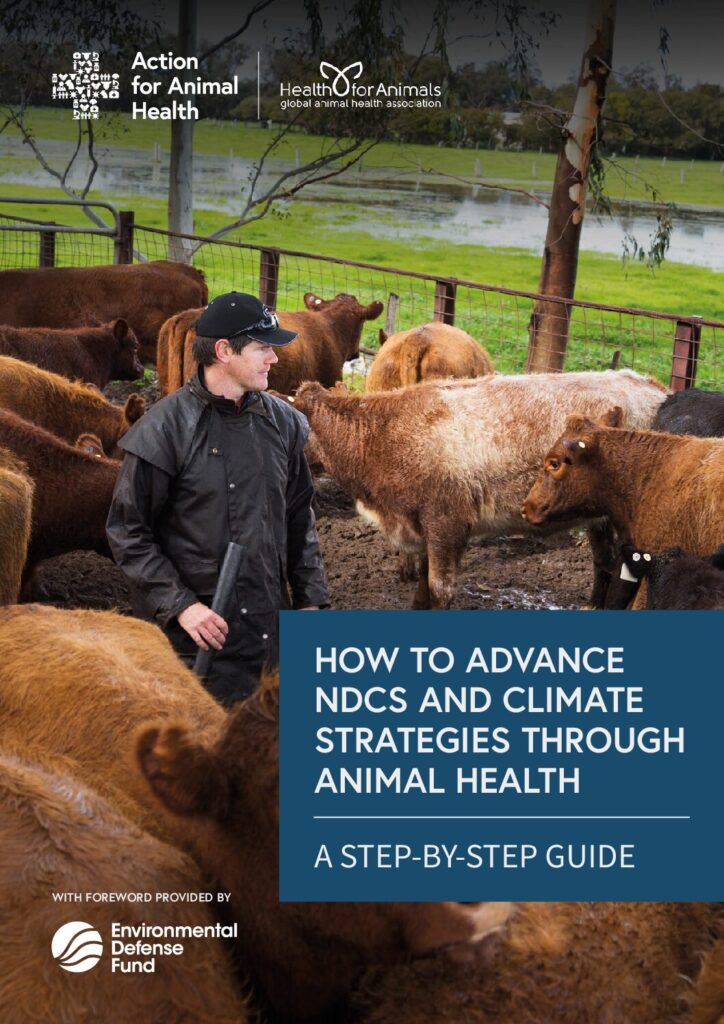
Reports: How to Advance NDCs and Climate Strategies through Animal Health
HealthforAnimals and Action for Animal Health, with contribution from the Environmental Defense Fund, have released a new Guide outlining how governments can leverage livestock health to meet national climate goals. ‘How to Advance NDCs and Climate Strategies through Animal Health – A Step by Step Guide’ provides clear, practical direction for using animal health to advance Nationally Determined Contributions (NDCs) and other climate strategies.
The Guide highlights proven interventions such as vaccination and disease prevention that can reduce emissions, improve resilience, and support food security. Furthermore, many of the strategies outlined leverage existing building blocks in place in many countries such as national disease control programs, veterinary services, etc. that can allow animal health to be scaled up quickly as a climate tool.
Below is a brief summary of How to Advance NDCs and Climate Strategies through Animal Health – A Step By Step Guide. The full guide can be downloaded here or using the link on the right side of the page.
Leveraging Animal Health in Climate Strategies: A Pathway for Achieving NDCs
Summary Document – download the complete Guide here
Case for Action
Animal agriculture is on the front lines of climate change. Livestock systems are both a source of emissions and acutely vulnerable to climate-related shocks, including growing numbers of disease outbreaks. Livestock provide nutrition, livelihoods, and economic value, particularly in low-and-middle income countries, that is threatened by climate change.
Current climate strategies often overlook a powerful and practical tool for addressing livestock sector’s footprint: animal health. Only 3% of second-round NDCs include animal health as a mitigation and/or adaptation tool, and only 0.01–0.02% of global climate finance is directed to livestock health.1UNFAO. The
role of animal health in national climate commitments. https://doi.org/10.4060/cc0431en,2HealthforAnimals, Financing for Animal Health – A gap in the sustainability agenda
This omission leaves a critical gap in efforts to reduce emissions and enhance resilience. Integrating animal health into national climate action is essential to close the mitigation gap while delivering food security and economic stability.

Proven Solution for NDCs
Animal health is a critical but underused lever for reducing emissions that when combined with related innovations in areas like genetics and rumen manipulation can reduce livestock emissions by an estimated 23%, according to FAO.3United Nations Food and Agriculture Organization (FAO), 2023. Pathways towards lower emissions Interventions like vaccination, parasite control, and diagnostics are established and deliver rapid impact.
Importantly, these solutions are also scalable and provide co-benefits. Many countries already operate national disease control programs and veterinary health systems. The opportunity lies in connecting national animal health activities with climate goals. This makes animal health a “no-regrets” investment that delivers co-benefits for adaptation, food security, and livelihoods, often using systems that are already in place.
Current climate plans fall short of global targets, and animal health can help change that. This shortfall, called the “mitigation gap”, is the gap between planned actions and the emissions cuts needed. In agriculture, that gap is 60% with livestock emissions reductions representing the second largest missing piece.4FAO, 2024. Agrifood systems in nationally determined contributions: Global analysis Better integration of animal health could help close this gap while delivering benefits for farmers, animals, and economies.
How to deliver on climate strategies through animal health
Delivering on national climate strategies through improved livestock health requires thoughtful planning and action. HealthforAnimals and Action for Animal Health have developed a step-by-step guide centered around three pillars for success: integration, execution, and measurement. This work aims to leverage existing programs and infrastructure that countries already have in place, which means climate action can be delivered without significant new outlays.
The first step is to integrate animal health into climate strategies by recognizing its role in national agricultural and climate priorities. This involves using established and emerging frameworks to build a country-specific understanding of how disease affects productivity and emissions. The Guide from HealthforAnimals and Action for Animal Health provides clear policy actions including:
- Assessing the livestock sector’s role in the national economy, food systems, and greenhouse gas profile
- Analyzing baseline emissions from livestock production, including total emissions and emissions intensity
- Estimating the impact of animal disease on productivity losses and associated emissions
- Mapping existing veterinary infrastructure, services, and policies that influence livestock health
- Modeling future risks and scenarios for animal health under different climate change trajectories (e.g., 1.5°C, 2°C, 3°C)
- Engaging value chain actors and identifying barriers to uptake of interventions, including regulatory, financial, and behavioral constraints
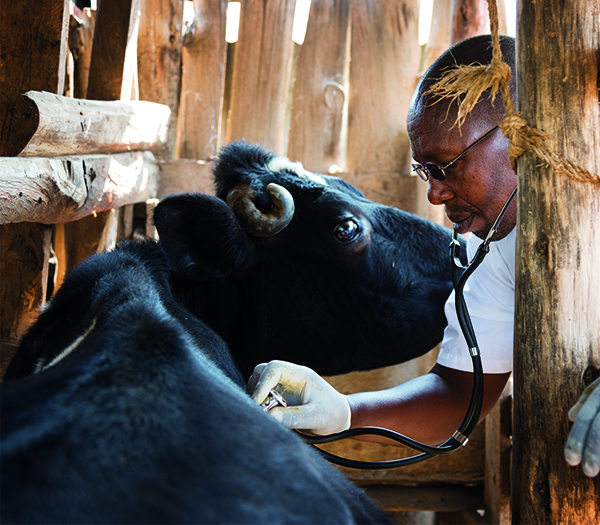
FAO calls animal health ‘one of the key action points to reduce livestock GHGs’ and should be integrated into NDCs.5HealthforAnimals, Financing for Animal Health – A gap in the sustainability agenda
The second step is to move from strategy to execution. Many countries already operate national vaccination campaigns, disease control programs, and veterinary extension systems. These efforts can be adapted and expanded to explicitly support climate goals. The Guide from HealthforAnimals and Action for Animal Health provides policy actions that countries can undertake including:
- Building capacity across public and private veterinary systems, including workforce training and infrastructure
- Developing technical expertise at the intersection of animal health and climate policy
- Engaging development partners and donors to secure funding and technical support
- Establishing Official Control Programs (OCPs) for high-priority endemic or transboundary diseases
- Supporting industry-led programs and public-private partnerships that extend reach and build producer trust
- Leveraging scientific networks to guide decision-making and ensure interventions are evidence-based
- Strengthening data systems to improve coordination, innovation, and monitoring
The third step is to measure, report and verify impact to demonstrate progress and, where needed, unlock climate finance. Key actions to establishing a robust MRV system that are outlined in the Guide from HealthforAnimals Action for Animal Health include:
- Linking interventions to measurable indicators aligned with NDCs and national plans
- Implementing robust data stewardship to track and manage program outputs
- Scheduling evaluations and reporting cycles to meet international standards
- Developing livestock emissions inventories using IPCC guidance and national data
- Building verification capacity within veterinary services to ensure accuracy and transparency
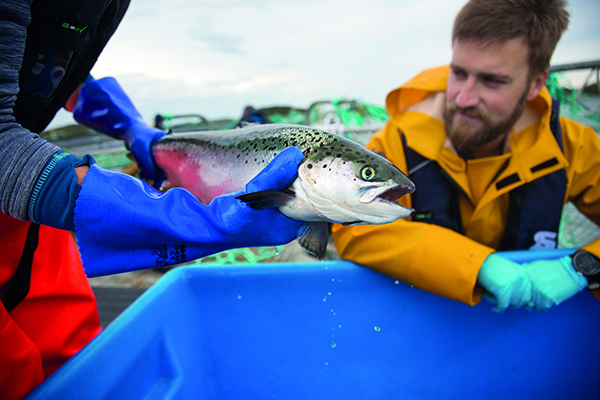
Only 3% of second-round NDCs included animal health as a mitigation or adaptation strategy—a missed opportunity for climate action.6UNFAO. The
role of animal health in national climate commitments. https://doi.org/10.4060/cc0431en,7HealthforAnimals, Financing for Animal Health – A gap in the sustainability agenda
Implementing these steps can help nations to leverage a tool – animal health – that will reduce livestock emissions in a meaningful, measurable manner, while delivering the co-benefits of increased farm productivity, better animal welfare, and improved public health.
Turning Potential into Action
Many countries already operate animal disease control programs and veterinary outreach systems. These provide a strong foundation that can be adapted to also support climate goals, which enables countries to unlock measurable emissions reductions, boost resilience, and deliver progress on their NDCs.
This guide provides a clear, step-by-step approach to help countries align animal health with national climate strategies. It outlines practical actions and reporting tools that can help turn existing veterinary infrastructure into a climate solution.
As the Environmental Defense Fund writes in the foreword,
“Animal health is not peripheral to addressing climate change. It is central to answering the call for solutions that provide multiple wins.”

Leveraging animal health as a climate solution creates a unique opportunity to deliver on global goals through practical action and shared commitment.
- 1UNFAO. The
role of animal health in national climate commitments. https://doi.org/10.4060/cc0431en ↩︎ - 2HealthforAnimals, Financing for Animal Health – A gap in the sustainability agenda ↩︎
- 3United Nations Food and Agriculture Organization (FAO), 2023. Pathways towards lower emissions ↩︎
- 4
- 5HealthforAnimals, Financing for Animal Health – A gap in the sustainability agenda ↩︎
- 6UNFAO. The
role of animal health in national climate commitments. https://doi.org/10.4060/cc0431en ↩︎ - 7HealthforAnimals, Financing for Animal Health – A gap in the sustainability agenda ↩︎